Q. You transferred to Dallas Bishop Lynch after
spending your first two years of high school at St. Mark's. What went into that
decision, and what was the biggest adjustment when you arrived at Bishop Lynch?
A. As the end of sophomore year approached, I had been putting more and more
pressure on myself in both academics and running. That pressure negatively
impacted both my grades and my running. Transferring schools gave me a new
start, but I also had to change how I managed everything. I became more
intentional about my time and priorities. I chose challenging coursework junior
year while getting involved in my school community, continuing my training
commitments, and earning all A's. That year showed me I could still have high
standards without the all-or-nothing approach I had relied on before. The
biggest change was the new team and coaching environment. Coach Kantor and one
specific teammate, Dash Raya, made the transition really smooth and quickly
welcomed me into the family. Coach Kantor gave me a place where I felt trusted,
but he also challenged me to become a better runner and person. Looking back, I
think God put me in the right place at the right time. Bishop Lynch gave me the
opportunity to grow not just as an athlete, but in my faith, relationships, and
understanding of what it means to be part of a community.
Q. Looking back now, how has the move to
Bishop Lynch affected you both as a runner and as a person?
A. I
think it's made me much more well-rounded. As a runner, I've learned that
working harder doesn't always mean doing more. I had a season where I was
training really hard but wasn't getting the results I wanted, and that forced
me to rethink how I trained. As a person, Bishop Lynch has helped me get
outside of my comfort zone. When I first transferred, I was pretty focused on
academics and running, but I started getting more involved with my house, my
classmates, and the team. I've learned that I don't want my identity to just be
my grades or my race times. I want to be someone who contributes to the
community around me.
Q. You've made a significant jump as a
distance runner. What has changed most in your training, mindset, or approach
to racing over the past two years?
A. The biggest change has probably been learning that more isn't always
better. After a disappointing cross country season, I realized that I couldn't
just keep adding miles and expect to get faster. I started working with an
outside coach, and he introduced me to a completely different approach that
included more recovery and cross-training. Coach Kantor also helped reinforce
the importance of trusting the process and listening to people who know more
than I do. At first, it was hard for me because I thought I always needed to be
doing more. But I've learned that improvement doesn't always happen
immediately, and sometimes faith means being patient and trusting that the work
you're putting in will eventually show. That's also changed how I race. I'm
better at staying present and adjusting when a race doesn't go exactly
according to plan instead of letting one bad split ruin the rest of the race.
Q. You opened this Cross Country season
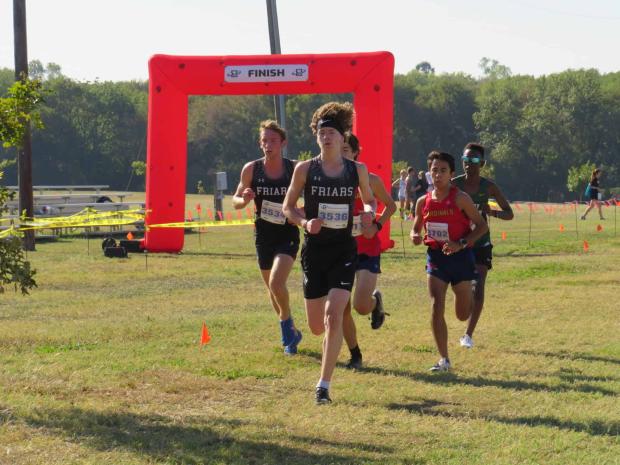
with a 15:13.90 5K, currently the fastest time in TAPPS. Take us through that
race. At what point did you realize you were having that kind of day? (Some
claim the course at Waxahachie is a little short, but you followed it up with a
15:43 in Tyler to prove your legitimacy.)
A. The lead-up to this race probably wasn't what you would expect before
running a 15:13. The night before, I had some disagreements and difficult
conversations with family members, and I ended up not eating dinner. Going into
race morning, I was already dealing with a lot of negative self-talk. I was
telling myself things like, "You're not good enough," and I was still thinking
about my underperformance at the Plano ISD 2-Mile. Once the race started,
though, I began to feel much better and more confident. My original plan was to
pace off a teammate I train with, but around 800 meters in, he lost his shoes.
I had to immediately shift to Plan B because my Plan A was no longer an option.
From there, I focused on staying present through the second mile and saving
enough to close hard over the final mile. I didn't realize just how good the
race was until I saw the time at the finish. The biggest thing I took away from
it was that I need to decide on a specific point in the race to start my kick
before I even get to the starting line. I had more left in the tank than I
realized at the end, so I think there's still more there.
Q. When you see 15:13 on the clock, are
you satisfied for a moment, or does your mind immediately go to breaking 15
minutes?
A. I was both satisfied and hungry for more. Satisfied because I was able to
showcase all the summer miles and work I put in. Hungry for more because with
such a quick opening race, and the 15:43 at Tyler Legacy, I am confident I can
improve my time enough to be in the mid 15:10's by NXR.
Q. Being the current TAPPS leader changes
the dynamic a little bit - instead of chasing someone, people are chasing you.
Do you like having that target on your back?
A. I like being a conference-wide known threat. I think I'm easy to
recognize at meets with the iconic hair and headband, and being known motivates
me to train harder and smarter knowing everyone is chasing the top spot. This
year's state meet will be different. Last year I ran and didn't even make the
top 30; this year, I believe I have a real opportunity to win state if I stay
healthy, consistent, and committed to my training. At the same time, my faith
has helped me keep that goal in perspective. I can control how I prepare, how I
compete, and how I treat people, but I can't control the final result. I
believe God has given me the ability to run, and I want to honor Him by making
the most of that ability rather than letting a time or place define me. So, I'm
excited about having a target on my back, but I'm also trying to trust God with
whatever happens on race day.
Q. What are your goals for your senior Cross
Country season? Is the focus primarily on times, winning a TAPPS individual
championship, helping Bishop Lynch accomplish something as a team, or some
combination of all three?
A. I set team and person goals at the beginning of this season. My team goal
is winning district entirely; last year we got second even with my first-place
finish. That showed me that I can improve myself all that I want, but if my
teammates aren't improving with me, we will lack our shot at the district
title. My personal goal is being on the podium at state. I also always set
reach goals for myself; my team reach goal is top 7 at state instead of last
year's top 10, and my personal reach goal is finishing as a top 5 unattached
runner at NXR south. A top 5 unattached finish would punch me a ticket to
compete at NXN in Portland, a dream I have had ever since freshman year.
Q. Your range is impressive: 1:58 in the 800, 4:27 in the 1600, 9:55 in the
3200 and 15:13 in the 5K. Which event do you consider your best event, and
which one do you enjoy racing the most?
A. I consider the 1600 my best event. I
think it encompasses both the 800 and 5k side of my wheelhouse. I enjoy the
1600 the most as well, it is not as short as the 800 where it is hard to race
strategically, but also not as long and grueling as the 5k. After running
4:23.45 in the full mile at Lonestar Showcase, I have big goals for the 1600
this year during track season.
Q. That 1:58 800 speed gives you
something many 5K runners don't have. How much confidence does that give you
late in a cross country race when it comes down to racing rather than simply
running for time?
A. It gives me the assurance that if it comes down to a kick 600-400m out, I
will bet on myself. After a surge in the Tyler Legacy 5k to secure 2nd
place and my defensive sprint at the end of Woodhouse, I can see the strides
after easy runs and the constant speed work integration paying off. I always
get excited when I can race an 800m because I have very few meets to do it at
and I always like to see how much faster I can go.
Q. You also ran 6:28.86 in the 2K
steeplechase this summer. What attracted you to the steeplechase, and what did
you learn from competing in such a different event?
A. My dad ran the steeplechase at TCU and after Coach Kantor pointed out how
useful it could be when talking to college coaches, who race the 3k
steeplechase, I decided to give it a try. I first tried it at the BVU and ran
6:28, 3 seconds away from Nike Outdoor Nationals auto-qualifying time. I
punched my ticket to NON however, in San Antonio, where I ran 6:24. The biggest
thing I learned from the steeplechase is simply how much time you can take off
when you are mechanically sound. I plan this track season to incorporate hurdle
and barrier practice into my workouts. My goal is to win the 2k Steeple at NON
and be able to jump over the barriers with either my right or left leg leading.
Q. Of all your personal records, which
performance means the most to you right now - and is there one PR you believe
doesn't accurately reflect what you're capable of?
A. I think the record I am most proud of is the 4:23.45 full mile, where
after a season of only PR'ing by a second taking my time down from
4:29->4:27 at TDF, I was able to clutch on my last attempt and ran lights
out. That has been by far the most memorable and fun track races I have ran
yet. I think my 3200 does not truly reflect the runner I am. With my 3200 at
9:51 and my 5k recently at 15:13 or 15:43, I believe there is much to uncover
this upcoming track season with how far I can progress in the 3200.
Q. How has training for cross country
changed the way you approach track, and conversely, how has your 800/1600 speed
influenced the type of cross country runner you've become?
A. Cross country has taught me a lot about patience and strength. You're
racing for a longer period of time, so you have to be comfortable not forcing
things early and trusting that your fitness will show up later. Track has given
me the opposite lesson in some ways. Running the 800 and 1600 has taught me how
to race aggressively and how to use speed when it matters. I think having that
800 speed gives me confidence in cross country because I know I have another
gear late in a race. At the same time, the strength I've developed from cross
country has made me a better track runner, especially in the 1600 and 3200.
Q. You're now a senior and one of the
runners younger athletes at Bishop Lynch look toward. How has your role on the
team changed from being the new transfer to becoming one of its leaders?
A. When I first got to Bishop Lynch, I was just trying to find my place. I
was the new guy, so I wasn't going to come in and immediately act like I knew
everything. Over time, I've become much more comfortable with the team and with
taking responsibility. Now, as a senior, I think leadership is less about
telling younger runners what to do and more about setting an example. My faith
has reinforced that idea for me. I think leadership is ultimately about serving
other people rather than being the person getting the most attention. I've
learned from my other leadership experiences that you don't necessarily have to
be the loudest person or have a title to make an impact. Sometimes it's just
listening to someone, helping them through a tough workout, encouraging them
when they're struggling, or making sure they feel like they belong. That's the
kind of leader I want to be for the younger guys, and that's something I've
learned from both my faith and the people who have invested in me, especially
Coach Kantor.
Q. You have one final cross country season and one final track season ahead
of you. When your Bishop Lynch career is over next spring, what do you want
people to remember about Harman Pope?
A. I hope people remember me as someone
who made the team and the school better, not just someone who ran fast.
Obviously, I want people to remember the races and the records, but I'd rather
be remembered for the relationships I built and the way I treated people. My
faith has shaped the way I think about that. I believe the abilities I've been
given are gifts from God, and I'm responsible for using them well and serving
the people around me. When I transferred here, I came in pretty focused on
academics and running. Bishop Lynch, my teammates, and Coach Kantor helped me
understand that being part of a community means contributing to it. Coach
Kantor has challenged me to become a better athlete, but more importantly, he's
been someone who has invested in me as a person. If younger runners can say
that I helped them, encouraged them, or made them feel like they belonged, I
think that would mean more to me than any particular time. Ultimately, I want
my time at Bishop Lynch to reflect my faith through the way I served the people
around me.
Q. Looking beyond Bishop Lynch, what are you looking for in a college
running program, and what kind of runner do you believe you can become at the
collegiate level?
A. The biggest thing for me is team
culture. After being on two separate teams I have been and made relationships
with a lot of older and younger boys. I am looking for a program that doesn't
expect me to be a finished product right when I walk on the team. I want the
coaches to believe in me and see the potential growth. I've learned through my
own training that I'm capable of improving a lot when I'm willing to listen and
try something different. So, at the college level, I want to be somewhere that
challenges me, but also somewhere I can contribute to the team and eventually
help younger runners the same way older teammates have helped me.
